Introduction
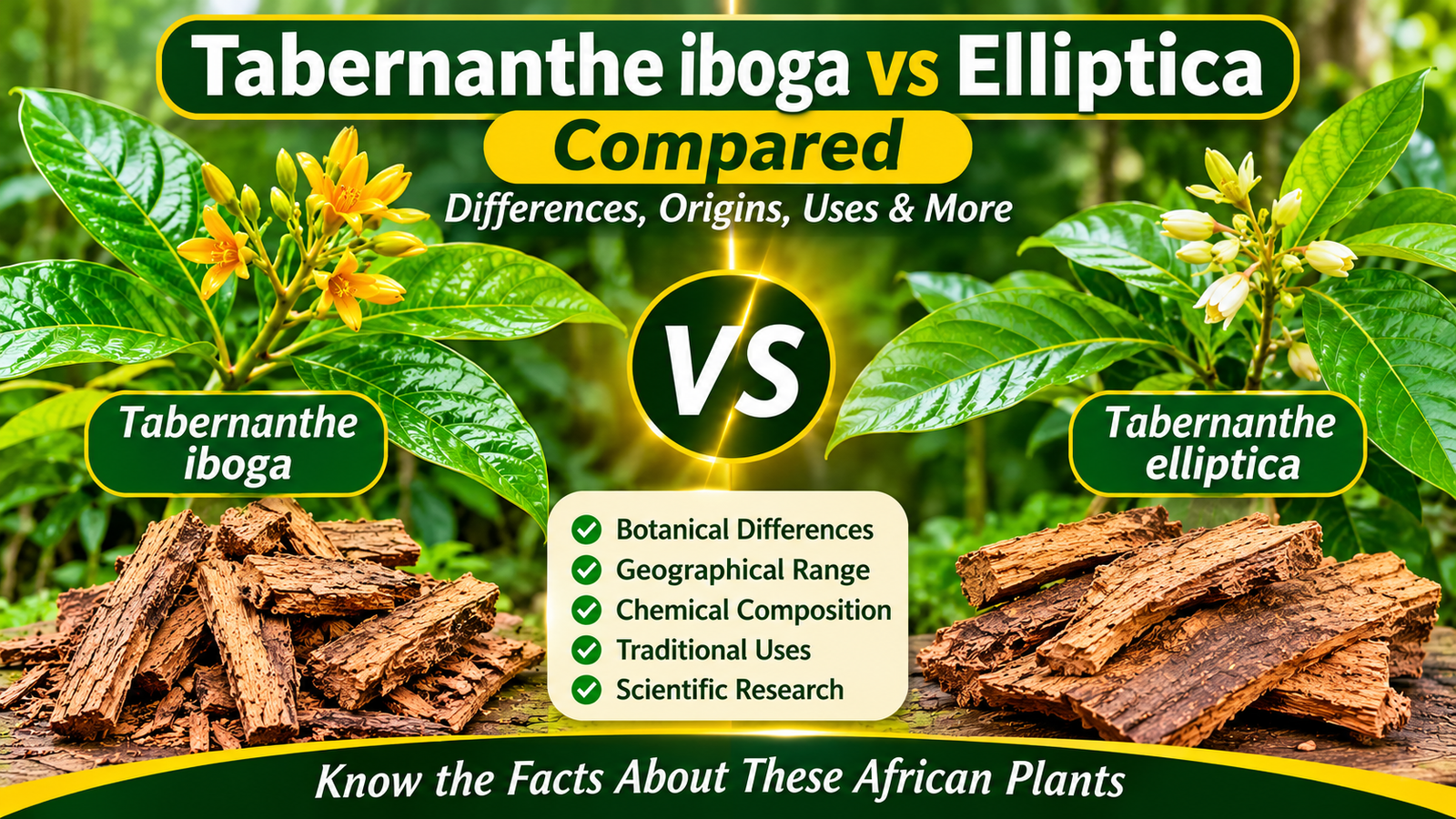
The African genus Tabernanthe contains two recognized botanical species: Tabernanthe iboga and Tabernanthe elliptica. Although these plants belong to the same genus and share several botanical characteristics, they are distinct species with differences in their geographical distribution, physical characteristics, and available scientific documentation.
Interest in both plants has grown as researchers, botanists, and enthusiasts explore the diversity of African medicinal and culturally significant plants.
Tabernanthe iboga is particularly well known because of its historical association with traditional spiritual practices in Central Africa and the presence of ibogaine, a naturally occurring psychoactive alkaloid.
By comparison, Tabernanthe elliptica is a less widely documented relative. Although botanical records confirm its existence as a distinct species, considerably less information is available about its chemical composition, traditional applications, and potential biological effects.
Understanding the differences between Tabernanthe iboga and Tabernanthe elliptica is important for accurate botanical identification, scientific research, conservation, and responsible discussion of African plant heritage.
This guide compares both species and examines what scientific evidence currently establishes about their similarities and differences.
1. What Is Tabernanthe Iboga?
Tabernanthe iboga is an evergreen shrub or small tree belonging to the Apocynaceae family. It is native to tropical Central Africa, where it grows in forest environments.
The plant is particularly associated with Gabon, Cameroon, the Republic of the Congo, the Democratic Republic of the Congo, and neighboring regions.
Iboga has considerable cultural significance in parts of Central Africa, especially within Bwiti traditions in Gabon.
Botanical characteristics
The plant typically features:
-
Dark green leaves.
-
A branching shrub-like growth structure.
-
Small flowers arranged in clusters.
-
Yellow-orange fruits when mature.
-
Roots containing several naturally occurring indole alkaloids.
One of the most extensively studied compounds found in Tabernanthe iboga is ibogaine.
Ibogaine has attracted scientific interest because of its complex effects on the nervous system and its investigation in substance-use disorder research.
Traditional significance
For generations, iboga has been associated with spiritual ceremonies, initiation practices, and traditional knowledge systems in Central Africa.
Its cultural significance extends beyond its botanical characteristics and is closely connected to the heritage of communities that have maintained traditional relationships with the plant.
Kew’s Plants of the World Online recognizes Tabernanthe iboga as an accepted botanical species.
Kew Science+1
2. What Is Tabernanthe Elliptica?
Tabernanthe elliptica is another recognized species belonging to the genus Tabernanthe and the Apocynaceae family.
It is a tropical African shrub primarily documented in the Republic of the Congo, the Democratic Republic of the Congo, and Angola.
Although it is closely related to Tabernanthe iboga, it is botanically distinct.
The species is sometimes discussed in connection with iboga because of its shared genus and geographical overlap. However, it should not automatically be treated as an alternative form of iboga.
Botanical characteristics
Botanical literature identifies several characteristics that help distinguish Tabernanthe elliptica from Tabernanthe iboga.
These include:
-
Differences in leaf vein patterns.
-
Distinctive fruit characteristics.
-
Differences in the structure of its reproductive organs.
-
Differences in geographical distribution.
One particularly important distinction concerns its fruits, which are described as having two separate follicles with soft, blunt projections.
Scientific documentation
Compared with Tabernanthe iboga, considerably less accessible research is available about the chemistry and biological properties of Tabernanthe elliptica.
A chemical research paper titled Alcaloïdes du Daturicarpa elliptica Stapf was published in 1976 under an earlier botanical name associated with the species.
This establishes a historical record of chemical investigation, but the existence of that publication alone does not establish a complete alkaloid profile or specific therapeutic properties.
The Royal Botanic Gardens, Kew recognizes Tabernanthe elliptica as an accepted species.
Kew Science+1
3. Tabernanthe Iboga vs. Tabernanthe Elliptica: Key Differences
Although the two plants belong to the same genus, their botanical characteristics and available scientific information differ.
The following comparison highlights the most important established distinctions.
| Feature | Tabernanthe iboga | Tabernanthe elliptica |
|---|---|---|
| Botanical family | Apocynaceae | Apocynaceae |
| Genus | Tabernanthe | Tabernanthe |
| Species status | Accepted species | Accepted species |
| Native distribution | Central Africa to Angola | Congo to northeastern Angola |
| Growth form | Shrub or small tree | Shrub |
| Leaf characteristics | Dark green leaves | Distinctive leaf vein pattern |
| Fruit characteristics | Variable fruit forms | Two separate follicles with blunt projections |
| Alkaloid research | More extensively documented | Limited accessible documentation |
| Ibogaine research | Extensive research compared with its relative | Insufficient species-specific evidence |
| Traditional significance | Strongly documented in certain Central African traditions | Less comprehensively documented |
| Scientific literature | Relatively extensive | Limited |
The botanical distinction is supported by Kew’s taxonomic records and published literature on the genus.
Kew Science+2
4. Differences in Geographical Distribution
Geographical distribution is another important factor when comparing these two species.
Both plants are native to tropical Africa, but their documented natural ranges are not identical.
Where does Tabernanthe iboga grow?
Tabernanthe iboga occurs across parts of West-Central Tropical Africa.
Its documented native distribution includes:
-
Cameroon.
-
Gabon.
-
Republic of the Congo.
-
Democratic Republic of the Congo.
-
Central African Republic.
-
Angola.
It is associated with tropical forest environments and grows as an understory shrub or small tree.
Where does Tabernanthe elliptica grow?
Tabernanthe elliptica has a more restricted documented distribution.
Kew records its native range as extending from the Congo region to northeastern Angola.
Its occurrence has also been documented in the Democratic Republic of the Congo.
Why geographical differences matter
Understanding the natural distribution of each species helps botanists distinguish genuine plant specimens from incorrectly labelled botanical material.
Geographical information is also relevant to biodiversity conservation, ecological research, and the protection of native plant populations.
The fact that both species occur in parts of the Congo Basin does not mean that they have identical ecological requirements or chemical characteristics.
Kew Science+1
5. Differences in Botanical Identification
Correct botanical identification is essential when studying related plant species.
Because Tabernanthe iboga and Tabernanthe elliptica share a genus, they may appear similar to people without specialist botanical knowledge.
However, taxonomic research identifies differences in their reproductive structures and leaf characteristics.
Leaf characteristics
The number and arrangement of lateral leaf veins can help distinguish the species.
Published botanical descriptions report approximately 4–7 pairs of lateral veins in Tabernanthe elliptica.
These characteristics should be considered alongside other botanical features rather than used as the sole basis for identification.
Fruit characteristics
Fruit structure is another important distinguishing feature.
Tabernanthe elliptica is described as having two separate follicles with soft, blunt projections.
In Tabernanthe iboga, fruit characteristics can vary, and the relationship between the two species is more complex than a simple visual comparison might suggest.
Reproductive structures
Botanical research also identifies differences in the structure of the carpels, which are the reproductive parts of flowering plants that develop into fruit.
These features are particularly important in formal taxonomic identification.
For accurate identification, researchers should use botanical keys, herbarium specimens, and expert examination rather than relying solely on photographs or commercial product descriptions.
6. Chemical Composition: Does Tabernanthe Elliptica Contain Ibogaine?
One of the most frequently raised questions about these species concerns their chemical composition.
Tabernanthe iboga is known for its naturally occurring indole alkaloids, particularly ibogaine.
The concentration of these compounds can vary according to the plant material, growing conditions, and preparation methods.
Alkaloids in Tabernanthe iboga
The root bark of Tabernanthe iboga contains several naturally occurring alkaloids.
Ibogaine is the most widely studied because of its psychoactive properties and its relevance to neurological research.
Other reported alkaloids include ibogaline and tabernanthine.
These compounds contribute to the plant’s complex chemical profile.
What is known about Tabernanthe elliptica?
The chemical composition of Tabernanthe elliptica is less thoroughly characterized in accessible modern scientific literature.
A 1976 publication documented chemical investigation of the species under its former botanical name, Daturicarpa elliptica.
However, it is important not to assume that the plant has the same alkaloid profile as Tabernanthe iboga.
In particular, the presence, concentration, and biological significance of specific compounds should be established through reliable species-specific chemical analysis.
Why this distinction matters
Different botanical species can produce different combinations and concentrations of naturally occurring chemicals.
Consequently, findings from studies involving Tabernanthe iboga cannot automatically be applied to Tabernanthe elliptica.
This distinction is especially important when discussing psychoactive effects, potential therapeutic applications, and health risks.
Pl@ntUse+2
7. Traditional Uses and Cultural Significance
One of the most significant differences between the two plants is the amount of documented cultural information available.
Tabernanthe iboga and African traditions
Tabernanthe iboga has a well-documented relationship with traditional practices in Gabon and neighboring Central African regions.
Within Bwiti traditions, the plant has been associated with:
-
Spiritual initiation ceremonies.
-
Traditional rites of passage.
-
Cultural and ancestral practices.
-
Spiritual reflection and community identity.
These practices are part of a living cultural heritage and should be discussed with respect for the communities that preserve them.
Tabernanthe elliptica and traditional knowledge
Much less reliable ethnographic information is available about the traditional applications of Tabernanthe elliptica.
Although the species has documented botanical and historical chemical records, these do not establish that it has the same ceremonial importance or traditional uses as Tabernanthe iboga.
It is therefore important to avoid assuming that the cultural history of iboga applies equally to every species within the genus.
8. Are There Differences in Their Potential Effects?
Another important question concerns whether Tabernanthe iboga and Tabernanthe elliptica produce similar effects.
The answer requires caution because the scientific evidence is not equally developed for both plants.
Effects associated with Tabernanthe iboga
The effects associated with Tabernanthe iboga are primarily linked to its naturally occurring alkaloids, particularly ibogaine.
Research involving ibogaine has documented psychoactive effects and interactions with several neurological systems.
Reported effects and adverse reactions include:
-
Changes in perception.
-
Altered consciousness.
-
Nausea and vomiting.
-
Dizziness.
-
Tremors.
-
Neurological disturbances.
-
Cardiovascular complications.
Ibogaine has also attracted scientific interest because of preliminary findings involving substance-use disorders.
However, it is not an established or risk-free addiction treatment.
Effects associated with Tabernanthe elliptica
There is insufficient reliable species-specific human research to establish the effects of Tabernanthe elliptica.
Its chemical composition and potential biological activity require further investigation.
Claims that it produces milder effects, offers a safer experience, or has specific therapeutic properties should not be accepted without reliable scientific evidence.
An important safety consideration
Ibogaine has been associated with QT interval prolongation and potentially fatal cardiac arrhythmias.
The absence of comparable clinical research on Tabernanthe elliptica should not be interpreted as evidence that it is safe.
Neither plant should be considered an ordinary herbal supplement or used as a substitute for medical treatment.
The Dutch National Institute for Public Health and the Environment (RIVM) has advised against using herbal preparations containing Tabernanthe iboga because of potentially serious health risks.
9. Hybridization Between Tabernanthe Iboga and Tabernanthe Elliptica
An interesting aspect of the relationship between these species is the possibility of hybridization.
Published botanical literature discusses evidence of hybridization between Tabernanthe iboga and Tabernanthe elliptica.
Hybridization occurs when two different plant species reproduce and produce offspring with characteristics influenced by both parent species.
This is particularly relevant when studying plants that share a geographical range and belong to the same genus.
Why hybridization matters
Hybridization may contribute to variation in:
-
Fruit characteristics.
-
Reproductive structures.
-
Botanical appearance.
-
Genetic characteristics.
It can also make botanical identification more complicated.
For researchers and conservationists, understanding hybridization is important when documenting plant populations and establishing accurate botanical classifications.
It is another reason why identifying iboga-related plants solely through commercial names or photographs can be unreliable.
10. Conservation and Sustainable Sourcing
Both Tabernanthe iboga and Tabernanthe elliptica are important components of Central African botanical diversity.
Growing international interest in iboga-related plants makes conservation and responsible sourcing increasingly relevant.
Protecting natural populations
Harvesting practices can affect plant populations, particularly when roots and root bark are removed.
Responsible conservation requires attention to:
-
Protection of natural forest habitats.
-
Sustainable harvesting practices.
-
Botanical identification.
-
Traceability of plant materials.
-
Scientific documentation of native populations.
Respecting African botanical heritage
Iboga has cultural importance that extends beyond its commercial and scientific interest.
Responsible botanical education should acknowledge the traditional knowledge of Central African communities and recognize the importance of protecting indigenous plant heritage.
Conservation should also consider the ecological needs of less widely studied species such as Tabernanthe elliptica.
11. Which Species Is More Widely Studied?
Based on the available scientific literature, Tabernanthe iboga is considerably better documented than Tabernanthe elliptica.
There are several reasons for this difference.
First, iboga has an established cultural history in Central Africa.
Second, its naturally occurring alkaloid ibogaine has attracted international pharmacological and medical research interest.
Third, its potential relationship with substance-use disorders has generated scientific publications and public discussion.
By comparison, Tabernanthe elliptica has a smaller accessible research record.
Its taxonomy and geographical distribution are documented, but additional research is needed to understand its chemistry, biological properties, ecological characteristics, and potential traditional applications.
This difference in research coverage should not be interpreted as proof that one species is inherently more valuable or beneficial than the other.
It simply reflects the current state of scientific knowledge.
Conclusion: Understanding Tabernanthe Iboga vs. Tabernanthe Elliptica
Tabernanthe iboga and Tabernanthe elliptica are two distinct botanical species belonging to the same African genus.
Although they share similarities in their classification and natural environment, they differ in their geographical distribution, physical characteristics, and the amount of available scientific and cultural documentation.
Tabernanthe iboga is particularly well known for its traditional significance in Central Africa and its naturally occurring alkaloid ibogaine, which has attracted considerable scientific attention.
Tabernanthe elliptica, on the other hand, remains less extensively studied, with important questions about its chemical composition, traditional applications, and biological properties still requiring investigation.
For anyone interested in African botanical diversity, understanding these distinctions is essential.
At Iboga Botanicals, responsible education means recognizing the importance of accurate plant identification, respecting African botanical heritage, supporting conservation, and distinguishing established scientific evidence from unverified claims.
Frequently Asked Questions (FAQs)
1. What is the difference between Tabernanthe iboga and Tabernanthe elliptica?
Both belong to the Apocynaceae family and the genus Tabernanthe, but they are separate botanical species. They differ in geographical distribution, leaf characteristics, fruit structures, and the amount of available scientific research.
2. Is Tabernanthe elliptica the same as iboga?
No. Tabernanthe elliptica is a distinct species closely related to Tabernanthe iboga. They share a genus but should not be treated as interchangeable botanical materials.
3. Does Tabernanthe elliptica contain ibogaine?
Historical chemical research has investigated Tabernanthe elliptica, but its modern, species-specific alkaloid profile is insufficiently documented in the accessible evidence. Its ibogaine content should not be assumed without reliable chemical analysis.
4. Where does Tabernanthe iboga grow naturally?
Tabernanthe iboga is native to parts of Central Africa, including Cameroon, Gabon, the Republic of the Congo, the Democratic Republic of the Congo, the Central African Republic, and Angola.
5. Where does Tabernanthe elliptica grow?
Its documented native range extends from the Congo region to northeastern Angola, including the Democratic Republic of the Congo.
6. Which species has more scientific research?
Tabernanthe iboga has substantially more published research, particularly concerning its alkaloids and ibogaine. Tabernanthe elliptica has a more limited research record.
7. Are the effects of Tabernanthe iboga and Tabernanthe elliptica the same?
There is insufficient scientific evidence to establish that their effects are the same. The chemical composition and potential biological activity of Tabernanthe elliptica require further investigation.
8. Can Tabernanthe iboga and Tabernanthe elliptica hybridize?
Published botanical literature reports evidence suggesting hybridization between the two species. This may contribute to variation in certain botanical characteristics.
9. Are Tabernanthe iboga and Tabernanthe elliptica medicinal plants?
Both have botanical and ethnobotanical research relevance. However, their traditional applications and chemical properties should be evaluated separately. Neither should be assumed to be a proven or safe medical treatment.
10. Why is Tabernanthe iboga more widely known?
Its traditional cultural significance in Central Africa and the international scientific interest in ibogaine have contributed to its greater recognition.
Scientific References and Further Reading
The following sources are useful for supporting the botanical comparison:
1. Royal Botanic Gardens, Kew – Plants of the World Online: Tabernanthe iboga. Botanical classification, accepted name, and geographical distribution.
https://powo.science.kew.org/taxon/56090-1
2. Royal Botanic Gardens, Kew – Plants of the World Online: Tabernanthe elliptica. Botanical classification and geographical distribution.
https://powo.science.kew.org/taxon/urn:lsid:ipni.org:names:945563-1
3. Leeuwenberg, A. J. M. (1989). Taxonomic revision of the genus Tabernanthe. Agricultural University Wageningen Papers. A key reference for understanding the botanical distinction between the two species.
https://edepot.wur.nl/468098
4. PROTA – Plant Resources of Tropical Africa: Tabernanthe iboga. Botanical characteristics, distribution, and traditional information.
https://plantuse.plantnet.org/en/Tabernanthe_iboga_%28PROTA%29
5. National Institute for Public Health and the Environment (RIVM). (2024). Risk Assessment of Herbal Preparations Containing Tabernanthe iboga.
https://www.rivm.nl/publicaties/risk-assessment-of-herbal-preparations-containing-tabernanthe-iboga
6. Muséum National d’Histoire Naturelle: Tabernanthe elliptica. Botanical taxonomic records and specimen information.
https://science.mnhn.fr/taxon/species/tabernanthe/elliptica